
The Ides of March are unusually well remembered for a day so poorly documented at the bedside.
In Pompey’s curia
The Senate was meeting in Pompey’s complex when the conspirators gathered around Caesar. Suetonius describes the pretence of a petition, a hand seizing the toga and a first blow below the throat. He counts twenty-three wounds. His most consequential detail comes afterwards: the physician Antistius judged only the second wound, in the chest, fatal.[1]
Plutarch describes Caesar turning against Casca before finding blades on every side. He reports blows towards the face, a shallow neck wound and a wound to the groin, then places the fallen dictator beside Pompey’s statue. These are the locations reported by a biographer, with none of the measurements required to reconstruct their tracks.[2]
Nicolaus of Damascus makes the record less tidy. He describes injuries near the collarbone, side, face and thigh, and gives a total of thirty-five. The familiar twenty-three should therefore travel with its attribution. No surviving examination identifies the damaged organ or the amount of blood lost.[3]
The chest as a closed space
A blade entering the chest can injure lung, heart or major vessels. Blood accumulating in the pleural cavity both removes circulating volume and restricts ventilation. Air under pressure can obstruct venous return. Blood confined around the heart can impair filling. Each mechanism is anatomically plausible; none has been established for Caesar.[4]
The external wound may give little indication of the danger beneath it. Accessible bleeding can be compressed. Bleeding within the chest generally requires a route to definitive control. No ancient account describes the deterioration in enough detail to assign a shock class or an arrest rhythm.[4]
Where the blood goes
Choose a compartment. These are alternative consequences of penetrating trauma, not a documented sequence in Caesar.
Accessible haemorrhage
A bleeding vessel in accessible tissue may respond to direct pressure and appropriate haemorrhage control. The visible bleeding does not exclude an internal injury.[6]
Haemothorax
Blood collects around the lung. Circulating volume is lost into a space where an external dressing cannot reach the source.[4]
Cardiac tamponade
Blood collecting in the pericardium, the sac around the heart, can restrict the heart’s filling. This is one possible consequence of a penetrating heart injury.[4]
Accessible haemorrhage
A bleeding vessel in accessible tissue may respond to direct pressure and appropriate haemorrhage control. The visible bleeding does not exclude an internal injury.[6]
Haemothorax
Blood collects around the lung. Circulating volume is lost into a space where an external dressing cannot reach the source.[4]
Cardiac tamponade
Blood collecting in the pericardium, the sac around the heart, can restrict the heart’s filling. This is one possible consequence of a penetrating heart injury.[4]
Educational mechanism study. These panels explain the case and are not standalone treatment protocols.
What the medicus could reach
Celsus, writing in the early imperial period after Caesar’s death, describes lint, a compressed sponge, ligatures and cautery for bleeding. His text also includes vinegar among the treatments. This is evidence for the repertoire of ancient medicine, not a record of what Antistius used or a recommendation to reproduce it.[5]
The practical distinction was access. A vessel exposed in a wound offered the possibility of pressure or ligation. A deep injury to the heart or a great vessel presented a very different problem. A litter and attendants might change the place of treatment; they could not supply modern transfusion, anaesthesia or thoracic surgery.[5]
A team at the scene today
Once access is safe, immediate care addresses life-threatening external bleeding and failing breathing while evacuation is arranged. A casualty with suspected internal haemorrhage needs a destination capable of controlling it. Blood products may support circulation during that journey. They do not close the injured vessel.[6]
A penetrating chest wound alone does not justify decompression. The intervention depends on suspected tension pneumothorax and the patient’s physiological condition. Reassessment is essential because deterioration can change the treatment required.[7]
Resuscitative thoracotomy has a place in selected cases of traumatic arrest, when expertise, equipment and circumstances support it. It is a specialised attempt to reverse a treatable lesion. Its existence cannot tell us whether Caesar’s wound met those conditions.[8]
Could Caesar have survived?
Modern care offers a credible chance after some penetrating chest injuries, through rapid resuscitation and surgical haemorrhage control. Caesar’s actual lesion is unknown. Antistius left a judgement about lethality; the surviving text does not leave enough anatomy to overturn it.[1][4][8]
At the bedside
Three decisions about the clinical problem. The supplied findings are teaching scenarios; they are not additional historical observations.
Sources and notes
Sources checked 10 October 2026. Historical testimony, mechanism research and clinical guidance are identified separately. Modern guidance retains its stated setting and population.
- Suetonius, Julius 82Historical accountJ. C. Rolfe translation, 1913. Wound count and Antistius’s judgement.
- Plutarch, Caesar 66Historical accountReported attack and wound locations; a literary account.
- Nicolaus of Damascus, Life of AugustusHistorical accountSections 85–90. Alternative wound count and descriptions.
- WSES–AAST thoracic trauma guidelinesClinical guidance2025. Thoracic injury mechanisms and management; modern trauma setting.
- Celsus, De Medicina V.26Historical medicineSections 2–3, 21 and 24. Accessible bleeding and internal injuries.
- JTS, Damage Control ResuscitationClinical guidanceUS military CPG, 12 July 2019, update 29 August 2023. Still listed in the JTS index when checked.
- NICE NG39, Major traumaClinical guidance2016 recommendations, chest trauma and haemorrhage. UK major-trauma services.
- Resuscitation Council UK, Special circumstancesClinical guidance2025. Traumatic cardiac arrest and specialist interventions.
Artwork and provenance
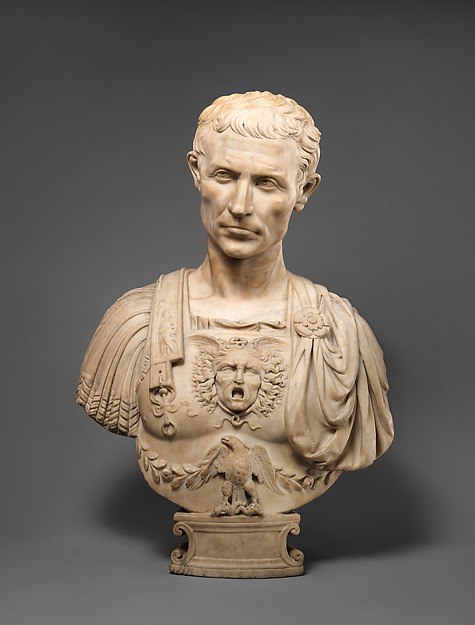
Andrea di Pietro di Marco Ferrucci, Julius Caesar, ca. 1512–14. The Metropolitan Museum of Art. Bequest of Benjamin Altman, 1913
Renaissance bust, ca. 1512–14; a later representation, not a surviving image of the assassination. Images are displayed in monochrome and framed to fit the page. The source images are served from this website.
CC0 1.0 / Public domain. Museum or collection record · Rights record · Original image