
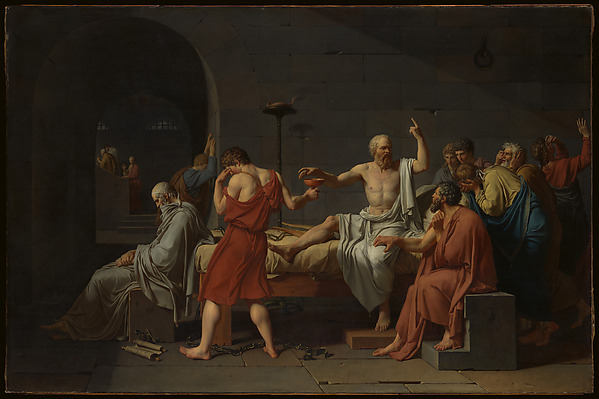
The final scene of the Phaedo is composed with such assurance that it is easy to mistake it for a clinical observation chart.
In the prison at Athens
Socrates spends his last day discussing the soul with his companions. When the appointed time comes, he drinks the poison. He walks until his legs become heavy, then lies down. The attendant tests his feet and legs. Loss of sensation and coldness advance upwards. Socrates speaks to Crito once more, asking him to discharge a debt to Asclepius.[1]
The dialogue places this account in Phaedo’s mouth. Plato records his own absence earlier in the work. The narrative has a philosophical purpose, and its closing physical observations are sparse. There is no measured respiratory rate, account of ventilation or recorded cardiac rhythm.[1]
This was an Athenian execution. To examine a modern rescue, we must first suppose that a treating team is allowed to intervene. That counterfactual changes the circumstances; it leaves the surviving testimony as it is.
The hemlock interpretation
Poison hemlock, Conium maculatum, is the conventional identification. Modern cases show that its effects can vary: vomiting, tremor, weakness, seizures and respiratory paralysis may occur. Plato’s quiet progression is therefore compatible with part of a poisoning syndrome, but cannot establish the exact substance or mixture administered.[2][3]
Coniine and related alkaloids interfere with nicotinic acetylcholine receptors. At the neuromuscular junction, normal signalling from nerve to muscle can fail. Profound weakness may involve the muscles of respiration. Inadequate ventilation then threatens oxygenation and allows carbon dioxide to accumulate.[3][4]
The distinction is clinically useful. A patient may still appear to understand what is happening while losing the ability to move enough air. Speech, airway protection and respiratory effort must be assessed repeatedly. A composed expression supplies no measurement of ventilation.[3]
When the muscles fall silent
Follow the physiological problem, from transmission at the receptor to failure of ventilation.
Nicotinic signalling
Hemlock alkaloids disturb signalling at nicotinic acetylcholine receptors, which normally help translate a nerve signal into muscle activation.[4]
Progressive weakness
Severe toxicity can produce flaccid paralysis. Limb weakness may accompany failure of the muscles needed to breathe.[3]
Insufficient air movement
Inadequate ventilation permits carbon dioxide to accumulate and threatens oxygenation. Giving oxygen does not restore lost muscular ventilation.[3]
Educational mechanism study. These panels explain the case and are not standalone treatment protocols.
Keeping the patient breathing
Suspected poisoning with progressive weakness requires urgent hospital care. Do not induce vomiting or give food or drink. Reassess consciousness and breathing; a patient who is unresponsive and not breathing normally requires immediate resuscitation. A safe photograph or retained sample may help identification, provided it does not delay care.[5]
A clinical team supports ventilation when spontaneous breathing becomes inadequate, with airway management as indicated. Supplemental oxygen cannot compensate for absent ventilation. Continued care addresses seizures, circulatory disturbance and complications such as muscle and renal injury while the toxic effects resolve.[3]
Specialist toxicology advice helps direct treatment. UK resuscitation guidance treats poisoning as a potentially reversible cause of arrest and allows prolonged efforts in appropriate circumstances while a toxin is metabolised or eliminated.[6]
An account of recovery
The National Capital Poison Center describes a patient with severe poison-hemlock poisoning who stopped breathing, received mechanical ventilation and recovered without lasting effects. It is evidence that respiratory failure from this toxin can be survivable with support. It cannot supply a probability of survival for Socrates.[2]
The time before adequate ventilation, the substance involved and the complications already present would all matter. None is recoverable with confidence from Plato’s final scene. The useful counterfactual concerns a treatable mechanism, rather than a promise about a particular ancient patient.
Could Socrates have survived?
Under the hemlock hypothesis, timely airway and ventilatory support could plausibly have prevented death from respiratory paralysis. The literary account cannot establish when irreversible injury occurred. The clinical opportunity is nonetheless substantial: sustain breathing while the toxin’s effects recede.[2][3]
At the bedside
Three decisions about the clinical problem. The supplied findings are teaching scenarios; they are not additional historical observations.
Sources and notes
Sources checked 10 October 2026. Historical testimony, mechanism research and clinical guidance are identified separately. Modern guidance retains its stated setting and population.
- Plato, PhaedoHistorical account59b; 117e–118a. Harvard Center for Hellenic Studies text.
- National Capital Poison Center, Poison hemlockPoison-centre educationClinical effects and a reported recovery following mechanical ventilation; checked 10 October 2026.
- Nunes et al., Acute intoxication with poison hemlockClinical case report2025. Supportive treatment and severe poisoning. A case report does not establish a universal protocol.
- Coniine receptor activity, experimental studyMechanistic research2008. Nicotinic receptor activity; used for mechanism, not treatment recommendations.
- NHS, PoisoningPublic clinical adviceUK first-response advice; checked 10 October 2026.
- Resuscitation Council UK, Special circumstancesClinical guidance2025. Toxins and resuscitation.
Artwork and provenance
Jacques Louis David, The Death of Socrates, 1787. The Metropolitan Museum of Art. Catharine Lorillard Wolfe Collection, Wolfe Fund, 1931
Jacques Louis David’s historical painting of 1787; a later artistic interpretation of Socrates’s death. Images are displayed in monochrome and framed to fit the page. The source images are served from this website.
CC0 1.0 / Public domain. Museum or collection record · Rights record · Original image