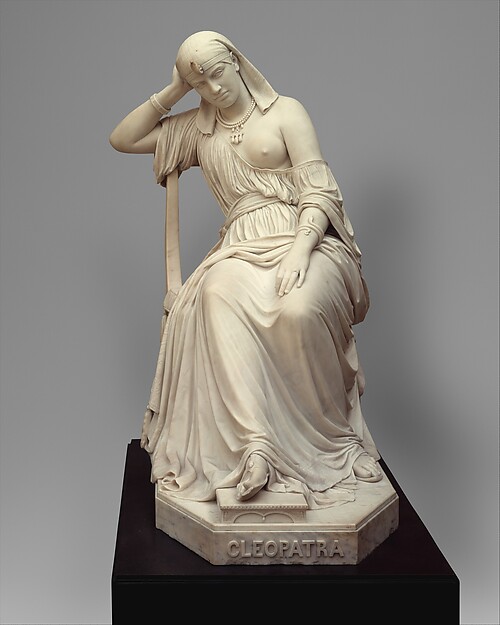
Plutarch leaves the manner of Cleopatra’s death uncertain. Centuries of painting have given it a much more definite shape.
The closed chamber
After Octavian’s victory, Cleopatra died at Alexandria. Plutarch describes messengers finding her dead, with Iras and Charmion dying beside her. He preserves the account of an asp, an alternative involving poison, and uncertain reports of marks on her arm. No snake was found in the chamber.[1]
Strabo likewise records competing explanations. Cassius Dio describes an attempted revival involving drugs and the Psylli, people credited with treating snakebite, while also acknowledging uncertainty about the death. The rescue story records an ancient response and belief; it cannot settle the diagnosis.[2][3]
An Egyptian cobra is a proposed identification within the snakebite interpretation. The sources establish neither a species nor a confirmed envenomation. The clinical case below therefore begins with an explicit assumption: a patient has suffered a neurotoxic cobra bite.
A small wound, a systemic effect
Some cobra toxins bind to receptors where nerves signal muscles to contract. These are nicotinic acetylcholine receptors at the neuromuscular junction. Blocking the signal weakens contraction and can paralyse the muscles needed for breathing.[4]
Drooping eyelids (ptosis), double vision, difficulty swallowing and weakening breathing are findings to seek in neurotoxic envenomation. A small bite site gives little reassurance. These findings concern the reconstructed patient; none is securely recorded for Cleopatra.[5]
The venom syndrome matters. Local swelling and tissue injury can accompany systemic effects in some cobra bites. Species, geography and the patient’s condition inform management. An elegant snake in a painting supplies none of those details.[5]
The cobra hypothesis
Explore a conditional mechanism. This is an account of possible envenomation, not a diagnosis of Cleopatra.
Postsynaptic neurotoxicity
Some cobra toxins interfere with nicotinic receptors on muscle, impairing the response to acetylcholine.[4]
Bulbar and ocular weakness
Drooping eyelids and difficulty swallowing can precede dangerous respiratory weakness. Repeat examination as the syndrome evolves.[5][6]
An effective regional product
Antivenom must be appropriate to the likely venom. Administration requires observation and readiness to treat reactions.[5][6]
Support while treatment acts
Assisted ventilation may remain necessary after antivenom. Do not wait for paralysis to resolve before supporting failing respiration.[6]
Postsynaptic neurotoxicity
Some cobra toxins interfere with nicotinic receptors on muscle, impairing the response to acetylcholine.[4]
Bulbar and ocular weakness
Drooping eyelids and difficulty swallowing can precede dangerous respiratory weakness. Repeat examination as the syndrome evolves.[5][6]
An effective regional product
Antivenom must be appropriate to the likely venom. Administration requires observation and readiness to treat reactions.[5][6]
Support while treatment acts
Assisted ventilation may remain necessary after antivenom. Do not wait for paralysis to resolve before supporting failing respiration.[6]
Educational mechanism study. These panels explain the case and are not standalone treatment protocols.
The response at the bedside
Move away from the snake, keep the casualty still and arrange urgent transport. Remove constricting jewellery and support the bitten limb to limit movement. Cutting, suction and arterial tourniquets can cause harm and delay effective treatment.[5]
Pressure immobilisation is not a universal snakebite measure. Its suitability depends on the venom syndrome, local effects and regional guidance. It should not be triggered by the generic word cobra alone.[5]
Failing breathing requires immediate support. Effective regional antivenom and ventilation are complementary treatments. Established paralysis may persist while the patient requires assisted ventilation. A team must also monitor circulation, the local injury and reactions to antivenom.[6]
The danger of waiting for certainty
A patient with a weak voice, dysphagia and declining respiratory effort needs treatment of that deterioration while the history is clarified. Waiting for a recovered snake can consume the period in which ventilation is easiest to support. The species may remain uncertain when the first useful actions have to be taken.[6]
At Alexandria we cannot know how long Cleopatra had been unresponsive, which toxin was involved or whether a bite occurred. Those absences prevent a numerical survival estimate. They also give the case its particular value: evidence can remain incomplete while a clinical priority becomes clear.
Could Cleopatra have survived?
If she suffered neurotoxic envenomation and was reached before irreversible hypoxic injury, ventilation and effective antivenom could have offered a route to survival. That conclusion belongs to the cobra hypothesis. The ancient accounts leave Cleopatra’s actual cause of death open.[1][2][5][6]
At the bedside
Three decisions about the clinical problem. The supplied findings are teaching scenarios; they are not additional historical observations.
Sources and notes
Sources checked 10 October 2026. Historical testimony, mechanism research and clinical guidance are identified separately. Modern guidance retains its stated setting and population.
- Plutarch, Antony 85–86Historical accountCompeting accounts of death; the absent snake and uncertain marks.
- Strabo, Geography 17.1.10Historical accountSnakebite and an alternative poison account.
- Cassius Dio, Roman History 51.14Historical accountThe reported attempt to revive Cleopatra and uncertainty about her death.
- Albulescu et al., A decoy-receptor approachMechanistic research2019. Experimental toxin research; used for receptor-level explanation only.
- WHO, Snakebite treatmentClinical guidanceGlobal guidance; first aid, regional antivenom and limits of pressure immobilisation. Checked 10 October 2026.
- JTS, Snakebite envenomationClinical guidanceVersion 1.1, publication date 27 April 2026 on the document cover; supersedes 30 June 2020. US deployed-care context; ventilation and antivenom.
Artwork and provenance
William Wetmore Story, Cleopatra, 1858, carved 1869. The Metropolitan Museum of Art. Gift of John Taylor Johnston, 1888
William Wetmore Story’s nineteenth-century interpretation; a later representation, not an ancient portrait. Images are displayed in monochrome and framed to fit the page. The source images are served from this website.
CC0 1.0 / Public domain. Museum or collection record · Rights record · Original image