
An emperor’s composure may survive longer in the historical record than his circulation survived at the bedside.
The last illness
Vespasian became unwell in Campania, returned to Rome and then went to Cutiliae, near Reate, where he usually spent the summer. Suetonius describes worsening bowel trouble. The emperor continued receiving visitors in bed, then suffered diarrhoea accompanied by near-collapse. He died as attendants helped him attempt to stand.[1]
“An emperor ought to die standing,” Suetonius has him say. The biographer also blames excessive use of cold water for the bowel complaint. That explanation belongs to the ancient account. It does not identify the disease.[1]
No reliable stool description, fluid balance or examination survives. Cholera, dysentery and a particular pathogen would all be diagnoses supplied by the modern author. The record supports diarrhoea and collapse; the fatal mechanism remains uncertain.
The losses accumulate
Persistent diarrhoea can remove water and electrolytes faster than they are replaced. Severe dehydration may progress to shock. Establishing the cause of the diarrhoea is a separate task from recognising that continuing losses have become dangerous.[2]
A modern assessment would examine drinking, vomiting, stool frequency and urine output, alongside mental state, breathing, pulse, blood pressure and peripheral perfusion. Existing cardiac or renal disease and current medicines could materially change fluid treatment.[3]
Thirst, dry mouth, reduced urine and persistent postural dizziness would support concern about dehydration. Confusion, cold skin, unusual drowsiness or breathing difficulty would demand urgent assessment. These are findings to seek in a present-day patient; Suetonius does not document them for Vespasian.[4]
A circulation losing volume
Consider what persistent diarrhoeal losses can do. These are possible mechanisms, not measurements from Vespasian.
Water and electrolytes
Losses that exceed intake can produce severe dehydration. The frequency of stools alone does not measure the whole deficit.[2]
Organ blood flow
A clinically important fluid deficit may compromise circulation. Mental state and peripheral perfusion belong in reassessment.[3]
Water and electrolytes
Losses that exceed intake can produce severe dehydration. The frequency of stools alone does not measure the whole deficit.[2]
Organ blood flow
A clinically important fluid deficit may compromise circulation. Mental state and peripheral perfusion belong in reassessment.[3]
Educational mechanism study. These panels explain the case and are not standalone treatment protocols.
Replacing what has been lost
An alert patient who can drink and protect the airway may benefit from oral rehydration solution. Its combination of glucose and electrolytes supports absorption and replacement of diarrhoeal losses. Continuing diarrhoea does not, by itself, make oral rehydration futile.[2][5]
Severe dehydration or shock requires urgent clinical treatment, including intravenous fluid when indicated. Fluid prescription is followed by reassessment of perfusion, urine output and tolerance. An older patient may also have comorbidities that make both under-treatment and excessive replacement hazardous.[3]
The underlying illness still needs investigation. Treating a fluid deficit does not establish why it occurred, and collapse can have more than one contributor. Dehydration, sepsis or an unrelated acute event remain possibilities that the historical account cannot separate.
The temptation of a simple answer
Diarrhoeal dehydration is treatable. That does not prove Vespasian’s death was preventable. We would need to know whether fluid loss caused his collapse and whether treatment could have reached him in time.
The surviving sentence about standing captures an emperor’s final gesture. The medical interest lies in the loss of function immediately before it. At a modern bedside, that deterioration would prompt reassessment and treatment without waiting for a memorable last remark.
Could Vespasian have survived?
If diarrhoeal dehydration was the principal cause of collapse, modern rehydration would offer a substantial opportunity to alter the outcome. The source is too brief to establish that premise. Vespasian supplies a defensible lesson in fluid loss, with the cause of his death left unresolved.[1][2][3]
At the bedside
Three decisions about the clinical problem. The supplied findings are teaching scenarios; they are not additional historical observations.
Sources and notes
Sources checked 10 October 2026. Historical testimony, mechanism research and clinical guidance are identified separately. Modern guidance retains its stated setting and population.
- Suetonius, Vespasian 24Historical accountJ. C. Rolfe translation. Final illness, diarrhoea, collapse and reported last remark.
- WHO, Diarrhoeal diseaseClinical education7 March 2024. Fluid and electrolyte losses and treatment. No paediatric doses are extrapolated.
- NICE CG174, Intravenous fluid therapy in adultsClinical guidance2013, updated 2017. Assessment and reassessment in adults in hospital.
- NHS, DehydrationPublic clinical adviceReviewed 1 May 2026. Symptoms, severe deterioration and oral replacement.
- WHO, Oral rehydration saltsClinical guidance2006. The role of oral rehydration across age groups; no preparation recipe or dose reproduced.
Artwork and provenance
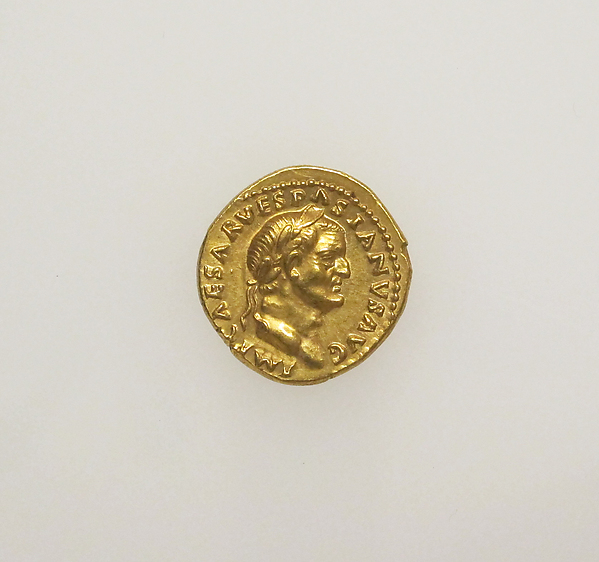
Unknown maker, Gold aureus of Vespasian, 70 CE. The Metropolitan Museum of Art. Gift of Joseph H. Durkee, 1899
Contemporary Roman gold aureus dated 70 CE, showing Vespasian on the obverse. Images are displayed in monochrome and framed to fit the page. The source images are served from this website.
CC0 1.0 / Public domain. Museum or collection record · Rights record · Original image