
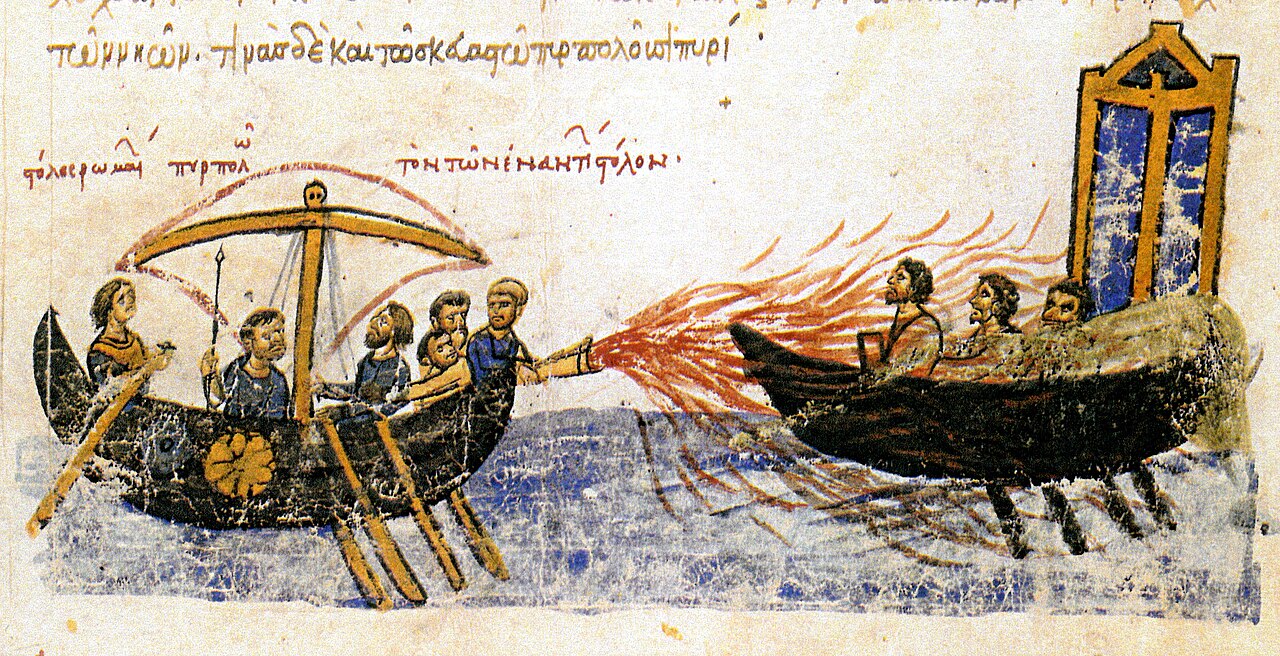
The fire is in the source. The sailor’s examination is a reconstruction.
The encounter in the Alexiad
Anna Komnene describes an imperial fleet pursuing Pisan ships in the eastern Mediterranean. Between Patara and Rhodes the vessels closed, and projected fire set several opposing ships alight. A squall added to the confusion. Metal animal heads at the Byzantine prows concealed the discharge tubes.[1]
The passage records the spectacle and the encounter. It supplies no individual burn assessment. The sailor here is an unnamed fictional composite, with findings authored for teaching. The substance’s precise composition remains disputed, so its toxicology cannot simply be borrowed from a modern incendiary.[1][2]
A casualty on the safe vessel
For this exercise, the sailor has reached safety. The fuel is extinguished and ongoing contamination controlled. His forearms and upper chest are burned. He coughs, speaks hoarsely and becomes increasingly short of breath. These are the scenario’s supplied observations.
The conspicuous skin injuries may draw attention away from breathing. Smoke exposure can injure the respiratory tract, and swelling may make a patent airway progressively harder to manage. Worsening obstruction requires urgent skilled intervention. Respiratory assessment, oxygen and evacuation accompany care of the burns.[3]
Carbon monoxide creates a separate difficulty: an ordinary pulse oximeter can appear reassuring despite impaired oxygen carriage. Exposure history and appropriate blood testing matter. The displayed saturation alone cannot exclude poisoning.[4]
Four problems after the fire
The sailor is fictional. His findings are supplied so that the treatment priorities can be examined.
Progressive obstruction
A changing voice and worsening breathing after smoke exposure demand urgent reassessment and skilled airway care.[3]
Carbon monoxide
Conventional pulse oximetry cannot reliably exclude carbon monoxide poisoning. Exposure and appropriate testing remain important.[4]
A thermal injury
Once the fuel is safe, appropriate cooling and covering limit further injury and protect the wound.[5][6]
Prevent further heat loss
Cooling injured tissue must be balanced with keeping the remainder of the casualty warm.[5]
Progressive obstruction
A changing voice and worsening breathing after smoke exposure demand urgent reassessment and skilled airway care.[3]
Carbon monoxide
Conventional pulse oximetry cannot reliably exclude carbon monoxide poisoning. Exposure and appropriate testing remain important.[4]
A thermal injury
Once the fuel is safe, appropriate cooling and covering limit further injury and protect the wound.[5][6]
Prevent further heat loss
Cooling injured tissue must be balanced with keeping the remainder of the casualty warm.[5]
Educational mechanism study. These panels explain the case and are not standalone treatment protocols.
Beyond the visible burn
A substantial burn can disturb fluid balance as vascular permeability increases and fluid moves into tissues. Perfusion may fall while swelling increases. Assessment of burn extent, circulation and associated injury guides monitored resuscitation. A burned casualty may also be bleeding from another injury.[3]
The patient is also vulnerable to heat loss. Exposed skin, wet dressings and prolonged treatment can compound the problem. The aim is to cool the thermal injury while protecting the person’s temperature, with particular care when a large area is involved.[5]
Cooling after the fuel is safe
Once burning and contamination are controlled, cool a thermal burn with cool running water for 20 minutes, starting promptly and ideally within three hours. Keep the remainder of the casualty warm. Ice, oils and creams are unsuitable initial treatments.[5]
Remove loose clothing and jewellery near the injury; leave material adherent to the skin in place. After cooling, use an appropriate protective covering. Cling film may be laid over suitable areas but should not be wrapped tightly around a limb. Deteriorating breathing takes priority over completing a dressing.[6]
Cooling a safe thermal wound is distinct from extinguishing an unknown burning substance. The historical uncertainty about Greek fire gives no authority to use water on active fuel. That hazard has already been controlled in this scenario.
What could modern care change?
Respiratory support, monitored resuscitation, wound surgery and specialist burn care could materially improve this sailor’s prospects. No historical individual or outcome is being claimed. The exercise turns on recognising the respiratory emergency while the skin injury remains the most obvious finding.[3][6]
At the bedside
Three decisions about the clinical problem. The supplied findings are teaching scenarios; they are not additional historical observations.
Sources and notes
Sources checked 10 October 2026. Historical testimony, mechanism research and clinical guidance are identified separately. Modern guidance retains its stated setting and population.
- Anna Komnene, Alexiad XI.10Historical accountElizabeth Dawes translation. The naval encounter between Patara and Rhodes.
- Kokoszko and Leszka, Naval fireHistorical researchDiscussion of evidence and uncertainty about the incendiary’s composition, pp. 10–12.
- BBA / ANZBA, Emergency Management of Severe BurnsClinical guidanceUK edition, 2020, 18th edition, pp. 35–39 and burn physiology chapters. Airway, circulation and associated injury.
- CDC, Clinical guidance for carbon monoxide poisoningClinical guidanceReviewed 21 August 2026. US guidance; limits of conventional pulse oximetry.
- BBA / National Burns Network, First aid statementClinical guidance7 August 2026. Cooling for 20 minutes within three hours and hypothermia prevention.
- NHS, Burns and scaldsPublic clinical adviceReviewed 31 March 2026. Clothing, cooling, wound covering and emergency assessment.
Artwork and provenance
Unknown illuminator, Greek fire against the fleet of Thomas the Slav, Madrid Skylitzes, folio 34v, 12th century. Biblioteca Nacional de España, Madrid. Madrid Skylitzes, Vitr. 26-2, folio 34v. Image via Wikimedia Commons.
The miniature depicts Greek fire against Thomas the Slav’s rebel fleet. It is contextual imagery for the Byzantine burn case, not a record of an individual patient. Images are displayed in monochrome and framed to fit the page. The source images are served from this website.
Public domain (PD-Art; PD-old-100-expired). Museum or collection record · Rights record · Original image