

Evidence standards
MACHAΩN separates current doctrine, supporting evidence, foundational physiology and historical context so that one is not mistaken for another.
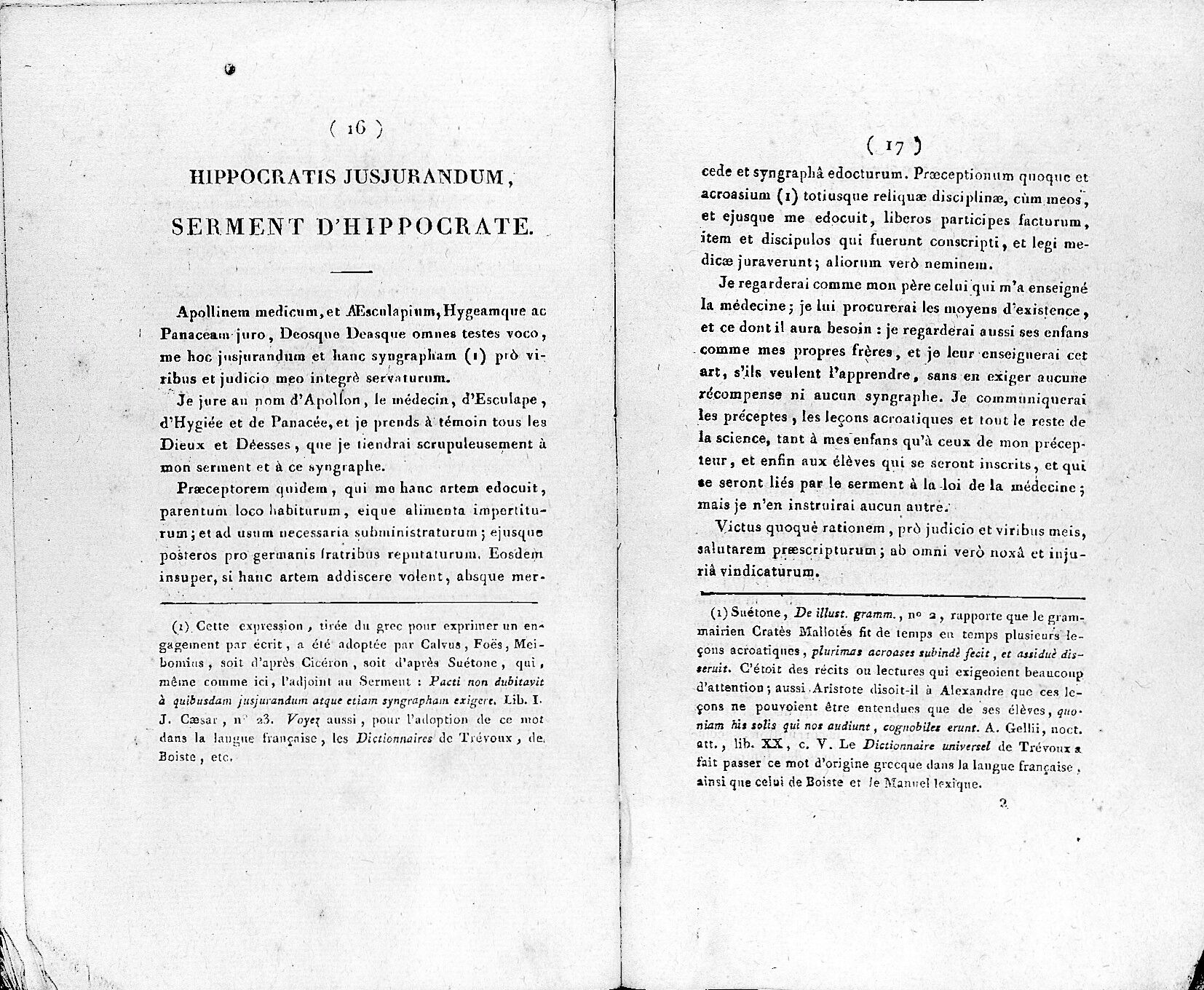
The Hippocratic Oath, 1818 edition
Pages from Jacques René Duval’s Serment d’Hippocrate, published in Paris in 1818.
Image source and licence
Jacques René Duval / Wellcome Collection · Source · Public Domain MarkOriginal colours and full image retained; scaled for display.Serment d'Hippocrate, précédé d'une notice sur les sermens en médecine / Par J.R. Duval.
Authority before convenience
Clinical teaching begins with the source set approved for that course. Current doctrine, national guidance and professional guidance control only the populations, jurisdictions and decisions they address.
Primary research, consensus statements and position statements may explain or challenge a recommendation. Foundational texts explain mechanism. Historical sources provide context. None silently acquires the authority of another category.
Uncertainty remains visible
Conflicting recommendations are presented as conflicts, not blended into a false universal rule. Missing evidence, safety concerns and jurisdictional limits remain explicit. Adult guidance is not extended to children, and military doctrine is not presented as UK civilian policy.
Drug doses, thresholds and procedural detail are included only when the controlling source supports them. Learners must verify current practice against their clinical governance, authorised protocol, scope of practice and local policy.
Version, date, correction
Clinical resources identify their controlling source, edition or publication date, population and evidence status. Each published clinical product receives a formal annual review and an event-driven review when its controlling source materially changes.
A credible safety concern triggers temporary withdrawal while the source record is checked. Material corrections are dated in the product record and affected purchasers are notified where contact details remain available. Superseded guidance is replaced, retained as clearly historical material, or removed from current teaching.
The founder remains the final publication authority. Evidence corrections can be sent through the MACHAΩN contact form. Patient-identifiable and operationally sensitive information must not be submitted.
Traceable to the issuing body
Course-specific registers identify the exact source used. Relevant issuing bodies include the Joint Trauma System and Committee on Tactical Combat Casualty Care, Resuscitation Council UK, NICE and the European Resuscitation Council. Inclusion here does not imply endorsement or that every source governs every course.