

PHASE IV · IN-TRANSIT CARE
In-Transit Care.
Movement can undo treatment. After loading, recheck interventions, establish monitoring and repeat the structured casualty assessment. Anticipate noise, vibration and restricted access.
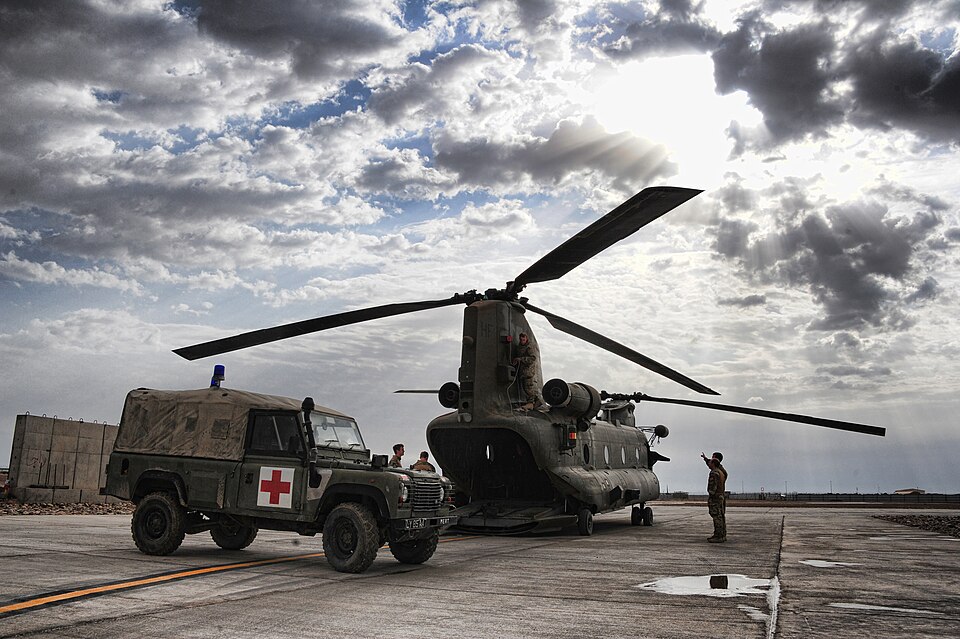
From helicopter to ground ambulance
An ambulance waits beside a Chinook at Camp Bastion, Afghanistan. Historical operational photograph; not a current equipment specification.
Image source and licence
© Crown copyright / Sergeant Alison Baskerville RLC · Source · OGL v1.0Monochrome display; full photograph retained. Original image available.An Ambulance Waits to Receive a Casualty from a Chinook at Camp Bastion, Afghanistan MOD 45152970.jpg
COURSE CONTENT
Online course · POA
Treatment has to survive the journey.
Ten modules and fifty decision checks cover care during movement, packaging, monitoring and reassessment. Cases include confirming handover information, crew coordination, fatigue, preparing for vomiting and tourniquet decisions.
Recheck
Confirming that haemorrhage control, airway devices, dressings, lines and other interventions remain effective after movement.
Monitoring
Selecting and interpreting monitoring appropriate to the casualty and transport environment.
Reassessment
Repeating structured assessment during transit rather than treating transport as a passive period.
Handover
Building a clear clinical picture and communicating changes, treatment and outstanding risks to the receiving team.
Learning and revision.
Clinical practice remains governed by your authorised protocols and scope of practice.