

Pharmacokinetics and Pharmacodynamics
Understand the drug. Understand the response.
RATIO MEDICAMENTORUM
Applied pharmacology for military medics and prehospital clinicians. Learn how medicines reach their targets, alter cell function and produce the changes you see in a casualty.
10 modules · 50 decision checks · Final assessment
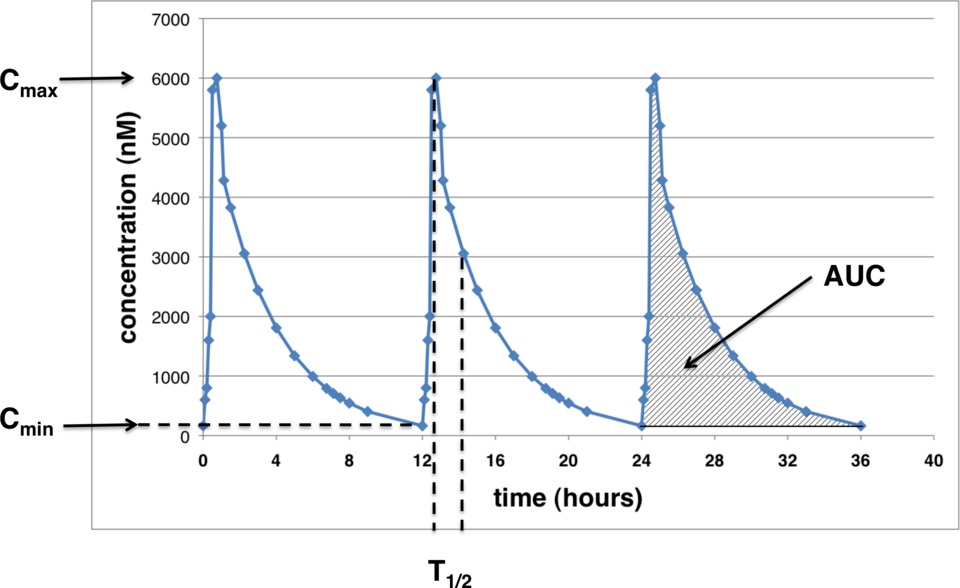
Plasma concentration over time with repeated administration
Illustrative plasma concentration–time curve with repeated administration. Values are a conceptual example, not a dosing schedule.
Image source and licence
Boghog2 · Source · Public domainOriginal colours and full image retained; scaled for display.Plasma concentration over time with repeated administration
What changed, and why?
Connect each medicine’s target to the casualty’s physiology, then account for delivery, clearance and time.
Build the foundations
Study how medicines enter, move through and leave the body, then examine receptors, ion channels and cell signalling.
Apply the mechanisms
Study adult casualty cases involving pain, altered consciousness, poor perfusion and prolonged evacuation. Compare the intended response with other observed effects.
Return to the medicines
A medicine index connects morphine, midazolam, ketamine, naloxone, lidocaine, salbutamol, adrenaline and tranexamic acid to the relevant explanations.
Course content
Start at Module I or resume where you left off. Each lesson includes an applied case, five decision checks with explanations, and a reflection prompt.
- I
The medicine and the casualty
Connect drug movement, target action and the response you observe.
- II
Absorption across membranes
Membranes, ionisation, local pH and perfusion.
- III
Bioavailability and first pass
Why route and formulation alter exposure.
- IV
Distribution and free drug
Tissue delivery, protein binding and changing casualty physiology.
- V
Metabolism and active products
Enzymes, metabolic pathways and active metabolites.
- VI
Excretion and the injured kidney
Clearance, filtration and the consequences of impaired renal function.
- VII
Receptors and cell signalling
How opioid receptors, nerve-cell signalling and ion channels respond to medicines.
- VIII
Affinity, efficacy and response
Agonists, antagonists and the link to pathophysiology.
- IX
Time, accumulation and interactions
Half-life, repeated exposure and combined drug effects.
- X
The evacuation handover
Apply PK and PD to a changing casualty and explain your reasoning.
Assessment and certificate
Complete all 50 checks correctly to open the 20-question final assessment. The pass mark is 80%. Revisit the explanations and retry when needed.
Completion certificate
A printable Certificate of Online Learning Completion records your name, date, score, course version and unique reference.
CPD reflection
Use the separate CPD section to record what you learned and how it relates to your practice. Download or print your reflection.
Continue between browsers
Save a progress file and restore it on another browser. Your purchase reference restores course access separately.
Adult-focused online knowledge learning. Completion records the course and assessment; it does not confer a clinical qualification or prescribing authority.
Pharmacokinetics and Pharmacodynamics
POA
One payment. Continuing course access.
Access for as long as MACHAΩN Academy operates, including course updates at no additional charge.
Price on application. VAT is not charged.
Already purchased?
Open the course in your existing browser, or restore access using the purchase reference saved after checkout. Keep that reference private.
Evidence and scope
The course uses pharmacology education literature, NHS Specialist Pharmacy Service guidance and UK product information. Sources are attached to the teaching and question explanations. UK civilian product information and military applications are identified separately.
The curriculum explains mechanisms and casualty physiology. It does not prescribe treatment protocols. See the Evidence standards.