

Control the threat. Move with purpose. Reassess everything.
Go straight to final assessment
Work through the complete point-of-wounding sequence, then apply it in a final integrated decision assessment.
Start with Module I.
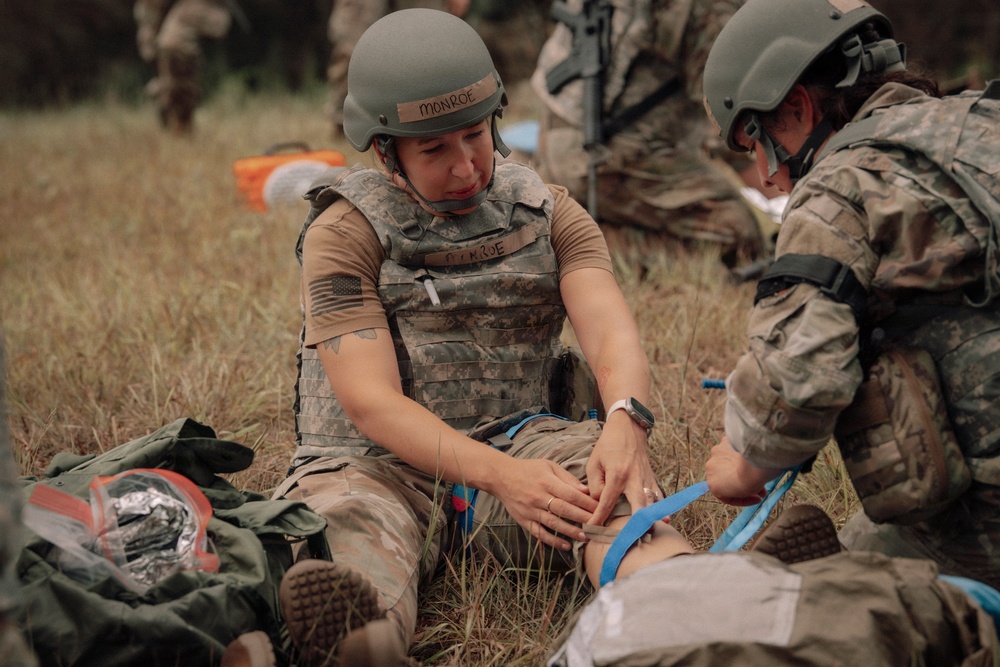
Haemorrhage control training
A medic practises tourniquet application on a simulated casualty during Northern Strike at Fort Custer, Michigan, 2026.
Image source and licence
Tech. Sgt. Bethany Rizor · Source · Public domain designation on itemMonochrome display; full photograph retained. Original image available.Air Guard medics train for care under fire during Northern Strike 26-2 [Image 13 of 23]
0 of 10 modules complete
Modules I-X
Each module ends with five shuffled, item-sourced operational decisions.
Point of Wounding
Explain how effective threat changes the order, location and extent of immediate casualty care.
Care Under Effective Threat
Apply the opening CUF priorities while avoiding the creation of additional casualties.
Self-Aid and Direction
Direct an able casualty to protect themselves, move and control life-threatening extremity bleeding.
Movement to Cover
Choose casualty movement and extraction actions that reduce exposure and prevent additional wounds.
Haemorrhage Under Fire
Control life-threatening external haemorrhage with the limited CUF actions authorised by current TCCC guidance.
Fire and Entrapment
Prioritise extraction from burning vehicles or structures and stop the burning process when tactically feasible.
Team and Tactical Integration
Integrate casualty actions with security, communication, fire control and multiple-casualty priorities.
Transition to Tactical Field Care
Recognise when to expand from CUF priorities into security, triage and a systematic Tactical Field Care assessment.
Communication and Documentation
Carry the point-of-wounding story into Tactical Field Care, evacuation preparation and documentation.
Kamdesh Decision Drill
Apply CUF and transition principles to a changing operational vignette while separating history from current doctrine.
Final decision assessment
Twenty sourced decisions. Pass requirement: 80%.